 Opals
Opals
 Gemstones
 Jewelry
 Coins
Coins


Ce produit est actuellement suspendu


Vous n'avez pas enchéri sur cette enchère.
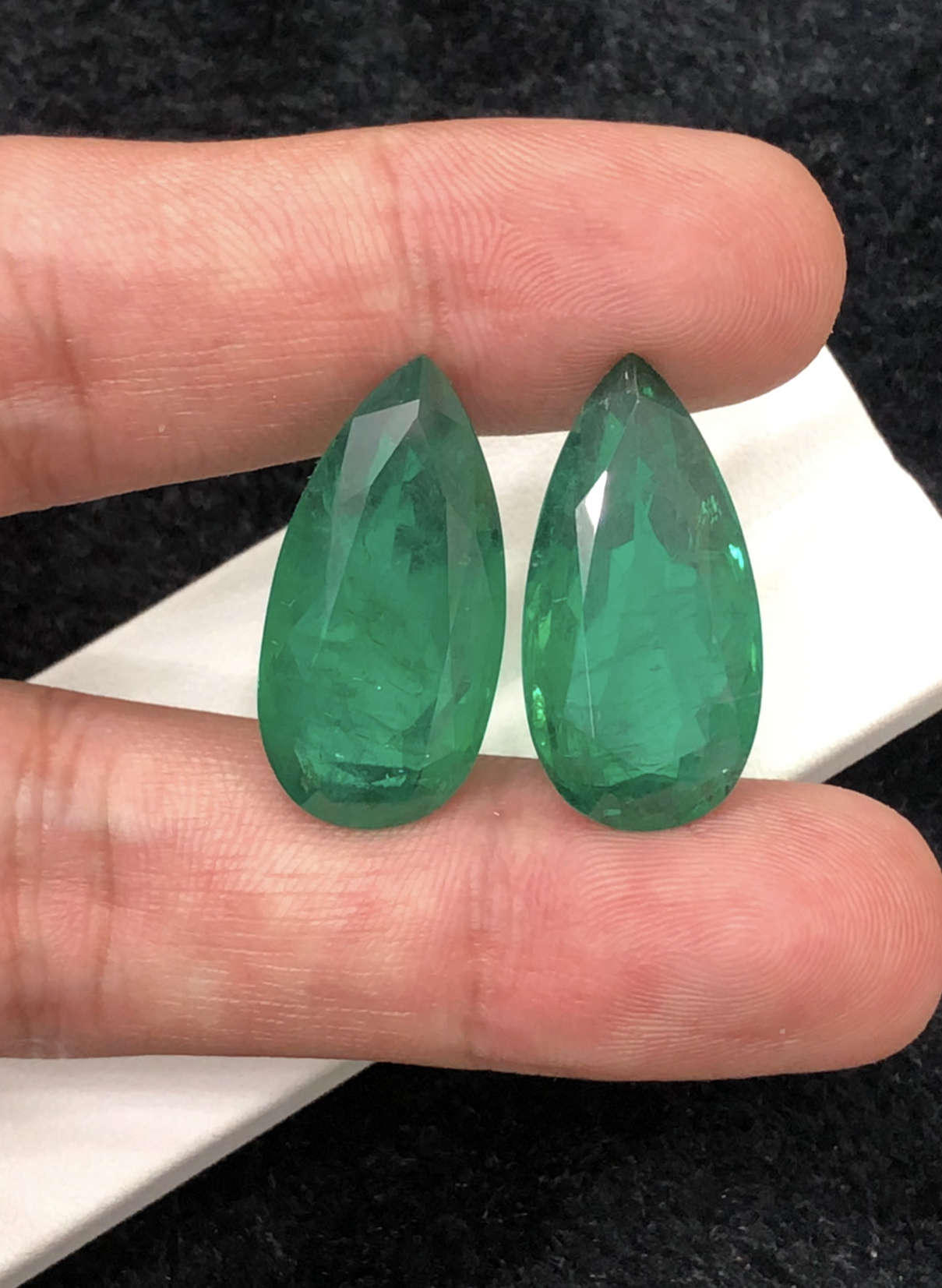
GRS Certified 52.75 Ct Natural Emerald From Zambia Mined
- UGS
- Dimensions (mm)
- 1 x 1 x 1mm
- Poids (cts)
- 52.75
- Treatment
- No Treatment
- Clarity
- SI
- Type
- Faceted
- Shape
- Pear, Drop
- Certificate Gem Lab
- GRS
- Couleurs
-
Zambia is considered the world’s second most important source of emeralds by value (after Colombia). The deposits are located near the Kafubu River in the Ndola Rural Restricted Area. Emeralds have been known from this region since 1928, but significant commercial production began only in the 1970s. As of mid-2004, most of the emeralds were being mined from large open- pit operations at the Kagem, Grizzly, and Chantete concessions. Economic emerald mineralization is confined almost entirely to phlogopite reaction zones adjacent to Be-bearing quartz-tourmaline veins that metasomatically altered Cr-bearing metabasite host rocks. Nearly all of the rough is cut in India and Israel. Zambian emeralds have relatively high R.I. and S.G. values, with inclusions typ- ically consisting of partially healed fissures, as well as actinolite, phlogopite, dravite, fluorapatite, magnetite, and hematite. They contain moderate amounts of Cr, Mg, and Na, moderate-to-high Fe contents, and relatively high Cs and Li. Although many features of Zambian emeralds are compara- ble to those from other commercially important localities, in many cases they may be separated by a combination of their physical properties, microscopic characteristics, and chemical composition.
| Fournisseur d'expédition | Expédition vers Pakistan | Expédition dans le reste du monde | Expédition combinée ( Pakistan ) | Expédition combinée (reste du monde) |
|---|---|---|---|---|
| Standard Shipping - Tracked |
|
|
|
|
| FedEx |
|
|
|
|
- UGS
- Dimensions (mm)
- 1 x 1 x 1 mm
- Poids (cts)
- 52.75
- Treatment
- No Treatment
- Clarity
- SI
- Type
- Faceted
- Shape
- Pear, Drop
- Certificate Gem Lab
- GRS
- Couleurs
-
Zambia is considered the world’s second most important source of emeralds by value (after Colombia). The deposits are located near the Kafubu River in the Ndola Rural Restricted Area. Emeralds have been known from this region since 1928, but significant commercial production began only in the 1970s. As of mid-2004, most of the emeralds were being mined from large open- pit operations at the Kagem, Grizzly, and Chantete concessions. Economic emerald mineralization is confined almost entirely to phlogopite reaction zones adjacent to Be-bearing quartz-tourmaline veins that metasomatically altered Cr-bearing metabasite host rocks. Nearly all of the rough is cut in India and Israel. Zambian emeralds have relatively high R.I. and S.G. values, with inclusions typ- ically consisting of partially healed fissures, as well as actinolite, phlogopite, dravite, fluorapatite, magnetite, and hematite. They contain moderate amounts of Cr, Mg, and Na, moderate-to-high Fe contents, and relatively high Cs and Li. Although many features of Zambian emeralds are compara- ble to those from other commercially important localities, in many cases they may be separated by a combination of their physical properties, microscopic characteristics, and chemical composition.
| Fournisseur d'expédition | Expédition vers Pakistan | Expédition dans le reste du monde | Expédition combinée ( Pakistan ) | Expédition combinée (reste du monde) |
|---|---|---|---|---|
| Standard Shipping - Tracked |
|
|
|
|
| FedEx |
|
|
|
|

We deal in all kind of gemstones (Precious & Semi Precious) and also Rare gemstones.
-
 Positif
Great fire in this lovely gemstone


-
Positif
It is very beautiful and shiny, thank you.


Pourquoi les utilisateurs se surenchérissent-ils ?
Lorsqu'une enchère est placée, il s'agit du montant maximum qu'une personne est prête à enchérir pour le produit. Notre système enchérira alors automatiquement au nom de l'enchérisseur, augmentant progressivement l'enchère jusqu'au maximum pour maintenir sa position de meilleur enchérisseur.
Lorsqu'une icône indiquant « Enchère automatique » apparaît, cela signifie que notre système place activement des enchères pour l'enchérisseur en fonction de son enchère maximale. Cela peut donner l'impression que les enchérisseurs se surenchérissent, mais c'est simplement le résultat de la mise à jour de l'enchère par le système pour refléter la limite maximale des enchérisseurs.
